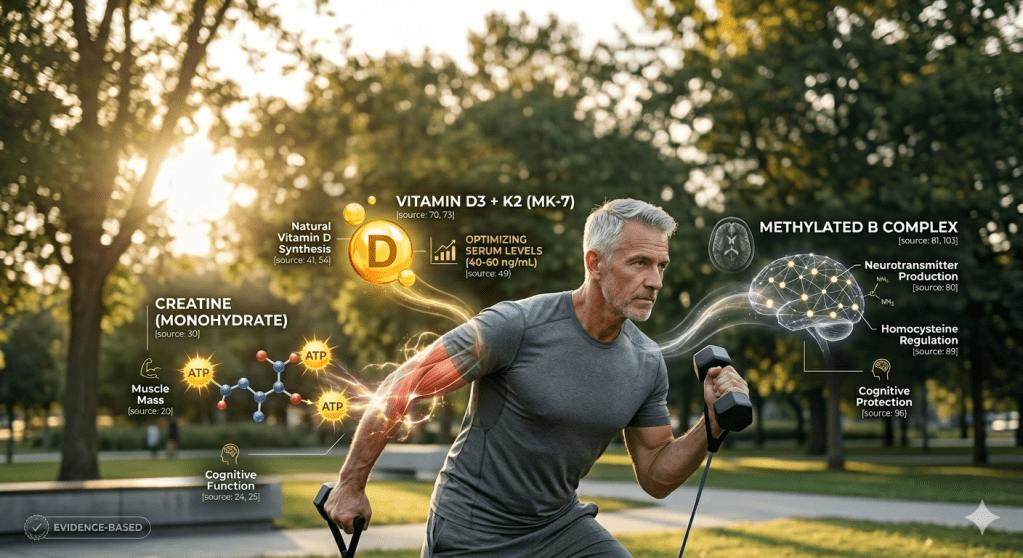
A deep dive into the three supplements with the strongest evidence base for men in their 50s and beyond
If you search for longevity supplements, you’ll find endless lists of pills backed by flimsy rat studies and affiliate links. Let’s skip all of that. For men over 50, there are really only three supplements with a bulletproof, decades-long evidence base: creatine, vitamin D, and a quality B-complex. They keep rising to the top not because they’re exciting or new, but because the evidence behind them is unusually strong, the safety profiles are well established, and the benefits they offer map directly onto what men in this age group need most. Here’s what the research actually shows.
Creatine: The Most Underrated Supplement for Men Over 50
If you associate creatine with bodybuilders loading up in their 20s, you’re about a decade behind the research. The population that arguably benefits most from creatine isn’t young athletes. It’s older men.
What creatine actually does
Creatine is not a hormone, a stimulant, or a synthetic compound. It’s a naturally occurring molecule synthesized in the body from three amino acids, glycine, arginine, and methionine, and stored primarily in skeletal muscle as phosphocreatine. Its core function is to rapidly regenerate ATP, the primary energy currency of your cells, during short bursts of high-intensity effort.
When you supplement with creatine, you increase the amount stored in muscle tissue beyond what diet and endogenous synthesis alone can provide. This has downstream effects that go well beyond gym performance.
Why it matters specifically after 50
Two things happen to men after 50 that creatine directly addresses. First, muscle loss accelerates. Second, cognitive function begins to show age-related changes that, while subtle early on, compound over time.
On the muscle side, a 2017 meta-analysis in the Journal of Strength and Conditioning Research examined creatine supplementation in older adults across multiple studies. The conclusion was clear: creatine combined with resistance training produced significantly greater gains in lean muscle mass and strength compared to resistance training alone. For men already battling sarcopenia, that’s a meaningful edge.
The cognitive angle is less widely known but increasingly well-supported. The brain is one of the most metabolically demanding organs in the body, and it relies on phosphocreatine as a rapid energy buffer during periods of cognitive load. A 2022 meta-analysis in Nutrition Reviews found measurable improvements in memory and processing speed from creatine supplementation, particularly in older adults and in situations of mental fatigue or stress.
One study from the University of Sydney found that vegetarians and older adults — two groups with lower baseline creatine stores — showed the most pronounced cognitive benefits from supplementation. Men over 50 who don’t eat red meat regularly are likely running with suboptimal creatine levels without knowing it.
What the research supports on dosing
The standard loading protocol (20 grams per day for five days followed by a maintenance dose) is not necessary for most men over 50. Research supports a straightforward approach of 3 to 5 grams per day taken consistently. There’s no meaningful benefit to cycling off creatine, and long-term safety at these doses is well established across decades of research.
Creatine monohydrate is the form with the most research behind it by a significant margin. Fancier, more expensive forms like creatine HCL or buffered creatine have not demonstrated superior outcomes in controlled studies. Buy monohydrate.
One practical note: creatine draws water into muscle cells, so some men notice a slight increase on the scale in the first week or two. This is intracellular water retention, not fat gain, and it’s a sign the supplement is working.
What to look for and how to take it
Look for products that are Creapure certified, a quality standard for creatine monohydrate manufactured in Germany that guarantees purity and is the form used in most clinical research. Unflavored powder is the most straightforward option. Capsules work but require more volume to hit the target dose.
One practical tip: creatine doesn’t dissolve well in cold water. Add 5 grams to your morning oatmeal or coffee instead. It mixes cleanly, and you’ll barely notice it’s there.
Vitamin D: The Deficiency Most Men Don’t Know They Have
Vitamin D is technically a hormone precursor, not a vitamin in the traditional sense. Your skin synthesizes it from sunlight exposure, and it regulates hundreds of biological processes through its receptor, which is found in nearly every tissue in the body. Given that profile, the widespread deficiency seen in men over 50 is a significant and largely silent problem.
Get your levels tested first
Before you start supplementing aggressively, get a blood test. A standard test measures serum 25(OH)D; this is what you ask your doctor for. The ranges that matter:
- Below 20 ng/mL: significant deficiency, warrants a conversation with your doctor about therapeutic dosing
- 20 to 30 ng/mL: deficient by most definitions
- 30 to 40 ng/mL: insufficient
- 40 to 60 ng/mL: the target range cited most frequently in longevity research
This matters because individual response to supplementation varies considerably based on baseline levels, body weight, and absorption. The dose that gets one man to 50 ng/mL might leave another stuck at 35.
How common is the deficiency
More common than most people expect. National Health and Nutrition Examination Survey data consistently show that a large proportion of American adults have insufficient vitamin D levels, with men over 50 disproportionately affected.
Skin synthesis of vitamin D declines with age; older skin is significantly less efficient at converting sunlight. Men in northern latitudes get minimal UV exposure for months at a time. Indoor work, sunscreen use, and limited dietary sources compound the problem. The result is that a man in his 50s living a normal modern life in most of the US has a meaningful chance of being deficient without any obvious symptoms.
What deficiency actually costs you
The consequences of chronic low vitamin D are not subtle when you look at the research collectively. Low levels are independently associated with reduced muscle strength and increased fall risk in older adults. A meta-analysis in the British Medical Journal found significant associations between vitamin D deficiency and increased cardiovascular disease risk. Separate research links insufficient vitamin D to impaired immune function, lower testosterone levels, increased depression risk, and poorer cognitive outcomes.
The bone health connection is well established — vitamin D is essential for calcium absorption, and deficiency is a primary driver of osteoporosis in older men, a condition that’s significantly underdiagnosed because it’s often framed as a women’s issue. Perhaps most relevant to longevity: a large-scale 2019 review in the British Medical Journal found that vitamin D supplementation was associated with reduced cancer mortality. The effect wasn’t massive, but it was consistent across studies and held up in meta-analysis.
Dosing and what to buy
The official Recommended Dietary Allowance for vitamin D is 600 to 800 IU per day for adults. Most longevity-focused researchers consider this inadequate for optimizing blood levels in men over 50 with limited sun exposure. Getting to the 40 to 60 ng/mL target typically requires 2,000 to 4,000 IU daily for most men, though, again, this varies.
Use vitamin D3, not D2. D3 is the same form your body produces from sunlight and raises serum levels more effectively in head-to-head comparisons. Vitamin D is fat-soluble, so take it with a meal containing some fat to improve absorption.
Vitamin K2 is worth pairing here. It works synergistically with vitamin D to direct calcium into bones rather than soft tissue. The form with the most research behind it is MK-7. Many quality D3 supplements now include K2 at appropriate doses.
If you’re correcting a known deficiency, discuss higher therapeutic doses with your doctor and retest after three months to confirm you’ve reached your target range.
B Complex: The Foundation Most Men Are Quietly Missing
The B vitamins don’t have the marketing power of creatine or the cultural moment that vitamin D has had. They’re not exciting. What they have is a quiet but essential role in nearly every metabolic process that determines how you feel and function day to day — and a set of age-related changes that make deficiency increasingly common in men over 50.
What the B vitamins actually do
There are eight B vitamins, and they function as coenzymes, meaning they’re required for enzymes to do their jobs across a wide range of metabolic processes. Energy production from food, DNA synthesis and repair, neurotransmitter production, red blood cell formation, and the regulation of homocysteine are all B-vitamin-dependent processes.
The ones that matter most for men over 50 are B12, B6, folate (B9), and B1 (thiamine), though the whole complex works synergistically enough that supplementing the full range makes more practical sense than isolating individual vitamins.
Why does deficiency become more common after 50
B12 deserves particular attention because the mechanism of deficiency changes with age in a way that makes dietary intake an unreliable indicator of status.
B12 from food requires a protein called intrinsic factor, produced in the stomach lining, to be absorbed properly. As men age, stomach acid production declines, meaning the body struggles to separate B12 from food proteins. Crystalline B12 from supplements is already free and bypasses this requirement, which is precisely why the National Academy of Medicine recommends that adults over 50 rely on fortified foods or supplements rather than whole food sources alone.
The consequences of B12 deficiency develop slowly and are frequently misattributed to normal aging: fatigue, brain fog, declining memory, peripheral neuropathy (numbness or tingling in the hands and feet), and mood changes. The serious part is that neurological damage from chronic B12 deficiency can become irreversible if left unaddressed long enough.
B6 and folate share an important function: along with B12, they’re responsible for converting homocysteine into less harmful compounds. Elevated homocysteine is an independent risk factor for cardiovascular disease and cognitive decline, and it’s one of the markers worth asking your doctor to test. High homocysteine is frequently a sign of inadequate B vitamin status rather than a primary condition in itself.
What the research shows on cognitive protection
The Oxford Project to Investigate Memory and Ageing (OPTIMA) produced some of the most compelling research in this area. Their work demonstrated that B vitamin supplementation in older adults with mild cognitive impairment and elevated homocysteine significantly slowed brain atrophy compared to placebo, measurably, on MRI scans. A follow-up analysis found that the protective effect was most pronounced in participants with adequate omega-3 levels, suggesting these nutrients work in combination.
For men in their 50s who are serious about protecting cognitive function long-term, the B vitamin case isn’t peripheral. It’s central.
The energy production angle
Beyond cognitive health, B vitamins are directly involved in converting the food you eat into usable cellular energy through the Krebs cycle. B1, B2, B3, and B5 all play specific roles in this process. Men who are chronically fatigued despite reasonable sleep and activity levels are sometimes running with suboptimal B vitamin status, particularly if they drink regularly (which depletes B1 and B6) or take metformin for blood sugar management (known to reduce B12 absorption).
What to look for and how to take it
Look for a methylated B complex rather than individual B vitamins, unless you’ve been specifically tested and found deficient in a single one. The key markers are methylcobalamin rather than cyanocobalamin for B12 and methylfolate rather than folic acid for B9. The methylated forms are more bioavailable and bypass a common genetic variant (MTHFR) that impairs conversion in a meaningful portion of the population.
Avoid megadose B complexes with 1,000 percent or more of the daily value for every nutrient. More is not better with B vitamins beyond a certain threshold, and B6 at very high doses can cause peripheral nerve problems with prolonged excessive intake. A complete complex at 100 to 400 percent of daily values is the target.
Take B complex in the morning with food. B vitamins are water-soluble and can cause nausea on an empty stomach, and the mild energizing effect makes evening dosing a bad idea for some men.
A Note on the Supplement Industry
The supplement market is largely unregulated in the United States. The FDA does not evaluate supplements for efficacy before they reach shelves, and quality control varies enormously between manufacturers.
When buying any supplement, look for third-party testing certifications from NSF International, USP, or Informed Sport. These verify that what’s on the label is actually in the product, in the stated amount, without harmful contaminants. It’s a lower bar than pharmaceutical standards, but meaningfully better than nothing.
The three supplements covered in this post have something important in common beyond their evidence base: they’re inexpensive. Creatine monohydrate, vitamin D3, and a quality B complex can be sourced for well under $50 per month combined. Anyone selling you on exotic, expensive alternatives to these fundamentals is working harder to separate you from your money than to improve your health.
Quick Reference: The Big Three
| Supplement | Daily Dose | Best Timing | Form to Buy |
| Creatine Monohydrate | 3-5g | Morning, with food | Creapure-certified powder |
| Vitamin D3 | 2,000-4,000 IU* | With largest meal | D3 softgel + K2 (MK-7) |
| B Complex | Per label (100-400% DV) | Morning, with food | Methylated (methylcobalamin + methylfolate) |
*Vitamin D dose depends on baseline blood levels. Get tested before supplementing aggressively.
The Honest Bottom Line
Supplements are not a substitute for the basics. Sleep, resistance training, adequate protein, stress management, and regular screening are the foundation. Supplements sit on top of that foundation, not underneath it.
With that said, these three earn their place. The research behind creatine, vitamin D, and B complex for men over 50 is not fringe or preliminary. It’s accumulated, replicated, and practically actionable. They address real gaps that become more common with age through mechanisms that are well understood, at doses that are safe and inexpensive.
Get your vitamin D levels tested. Add creatine monohydrate to your morning routine. Take a quality B complex with breakfast. Then focus the rest of your energy on the things that matter more.
Sources
Lanhers C, et al. (2017). Creatine Supplementation and Upper Limb Strength Performance: A Systematic Review and Meta-Analysis. Sports Medicine. doi:10.1007/s40279-016-0571-4
Avgerinos KI, et al. (2018). Effects of creatine supplementation on cognitive function of healthy individuals. Experimental Gerontology. doi:10.1016/j.exger.2018.04.013
Prokopidis K, et al. (2023). Effects of creatine supplementation on memory in healthy individuals. Nutrition Reviews. doi:10.1093/nutrit/nuac064
Chowdhury R, et al. (2014). Vitamin D and risk of cause-specific death. BMJ. doi:10.1136/bmj.g1903
Keum N, et al. (2019). Vitamin D supplementation and total cancer incidence and mortality. BMJ. doi:10.1136/bmj.l4673
National Academy of Medicine. (2019). Dietary Reference Intakes for Vitamin B12. National Academies Press.
Smith AD, et al. (2010). Homocysteine-Lowering by B Vitamins Slows the Rate of Accelerated Brain Atrophy in Mild Cognitive Impairment. PLOS ONE. doi:10.1371/journal.pone.0012244


Leave a comment